Then we walked to pick up the car and bring it back to the hotel to load our luggage. This is the road we drove out on. At this point, this sort of thing was still sort of a novelty, but soon we learned it is the absolute norm in Andalucian cities.

We set out for Granada, about two hours away. We opted to take a smaller road through the countryside rather than the big motorways, and it was a beautiful drive. There were olive groves the entire way. I had sort of planned to stop in a town called Baena, which is famous for its olive oil, but it was still raining when we passed through and getting out of the car didn't sound like too much fun.

Instead we pulled off in Alcala la Real, the last town before reaching Granada. The intention was just to kill some time so we wouldn't be too early arriving for check-in. We saw a sign pointing to what appeared to be a castle on the top of a hill, and thereby discovered that Alcala la Real is home to an ancient fortress, Fortaleza de la Mota, which is in ruins today. There were only a handful of other people there, which made it extra good for wandering around.


View of Alcala la Real below.


Just hanging out in a casual way at the top of the fortress.

The inside of the church was completely in ruins. Being in there gave us a very unsettling, almost creepy feeling. The uneven floor is actually the remains of ancient Visigothic tombs that the church was built on top of - the Visigoths lived in Andalucia even before the Moors arrived, in the 400s or so.

Once we reached Granada we looked it up and discovered the site has been uninhabited since Napoleon's troops burned the town (thereby collapsing the cathedral roof) when they were pushed out of the city in 1812. Great job, Napoleon.
Here is our attempt at a self-portrait outside the church.

In Granada we stayed in the Sacromonte, an historically gypsy neighborhood where everyone lives in caves built into the side of the hill. It was moderately harrowing getting there from the highway, as we had to drive through the very old Moorish quarter which was clearly not built for cars. Once again the Triposo app saved us from a wrong turn.
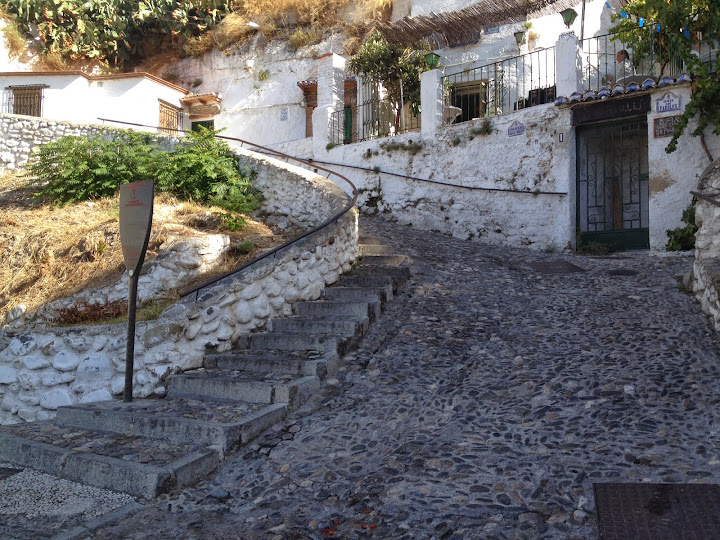
We (Ben) had to drag the suitcase up this little road, which we assumed was a footpath until we saw a car on it the next day. Most of the cars in Granada were covered in huge scratches on both sides - a cost of living in the old city, I guess.
In Granada we stayed in a cave hotel! I had originally booked a standard tourist hotel on the edge of town to avoid having to drive in the city center, but we talked about it and decided it was worth the risk to stay somewhere more atmospheric. Our cave hotel is in the right half of this picture:

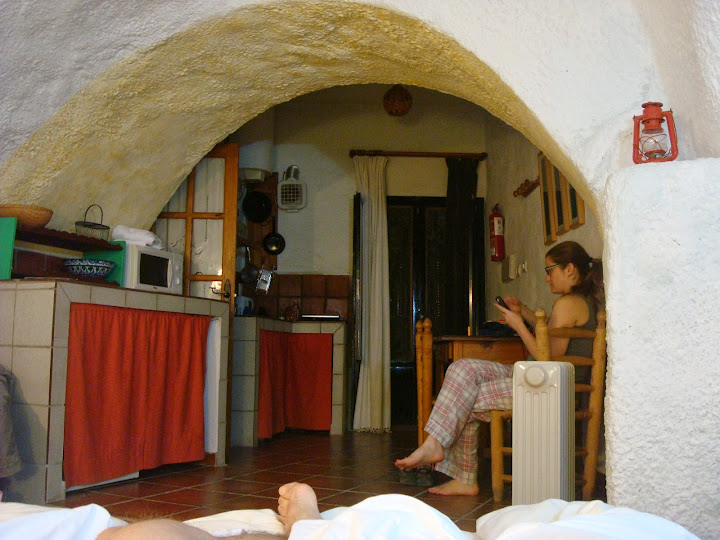
And here is our cave! It was pretty exciting. It stays at a constant temperature year-round so there is no need for air conditioning.

The proprietor told us that in three years of checking people into the caves, we were the first people to ever arrive precisely on time. I'm sure this does not come as a great surprise to people who know me.
This is the road on which Granadans apparently drive their cars, immediately outside our cave. Just around the bend there is a stunning view of the Alhambra.

We walked up the hill to the Albaycin, the old Moorish quarter of Granada. It is considered the best preserved Moorish neighborhood in Spain, and definitely had a Tunisian feel about it in places (which is our only experience with being in an old Muslim neighborhood).
In Granada there is still a culture of free tapas - meaning you order a drink and they bring you some free food as well. This is what they brought us - bread crumbs with melon and sausage. I later learned this is called migas in Spain, which is a completely different thing than migas in Latin America (tortillas scrambled with eggs). It was good, though. I'm going to figure out how to make it.

Lunch is the heavy meal of the day in Spain, and most restaurants have a thing called menu del dia, where you get three courses (starter, main, dessert) + bread and drinks, for much less than each item would cost individually. Usually they ran about $10-12 US, or, you know, the price of lunch at Chipotle. Depressing.
Here is what we got at the random place we stopped in the Albaycin - Ben's fried eggplant with "honey" (which is really molasses but everyplace we went called it honey), and my fried cheese with tomato sauce. If you guessed that both of these things were excellent you would be correct.

For my main I ordered the Alpujarras platter because I didn't know what it was. The waiter said it was "Andalucian specialties." It was seasoned fried potatoes, some various meats, and a fried egg. I ate it all up except the blood sausage. I draw a line at blood sausage.

Ben was on a fried squid kick for most of the trip. Also, every salad we got in Granada had corn on it, which was a little weird and unexpected.

After lunch we walked down the hill through the Albaycin.

We saw our first stray cats! We saw cats in every city, but Granada had the most.

They like cats there.

It's nice that they give you a heads up about 1.8 meters being physically impossible. We drove on a street that was 1.9.

The guidebooks we had did not seem too enthusiastic about Granada's cathedral, but we went inside anyway and thought it was very impressive. We sat for a long time just looking around.


And then we walked back up to our hotel along the Rio Darro.

There was a cat giving himself a bath down on the riverbank! When we got back to the cave I read in Rick Steves' book, "look out for feral cats on the riverbank." How does he know?? Rick is a genius.

For dinner we had a picnic on the patio outside our cave. There was a little orange kitten running around all night meowing at the top of his lungs, which made us feel right at home.
Here I am on the internet in the cave!
I will never travel internationally without an iPhone again - in addition to the maps/GPS issue, it was so helpful to be able to check in at the end of the day and read about the things we saw. I didn't activate it for use overseas but with wifi you can even talk on the phone via facetime and it's all free! The world is basically amazing.