Thursday, October 10, 2013

Trip Report! Day 3: Cordoba to Granada

We started off our morning in Cordoba with some nice pastries in the cafe adjoining our hotel. Pastries for breakfast are one of my favorite things about vacation.


Then we walked to pick up the car and bring it back to the hotel to load our luggage. This is the road we drove out on. At this point, this sort of thing was still sort of a novelty, but soon we learned it is the absolute norm in Andalucian cities.


We set out for Granada, about two hours away. We opted to take a smaller road through the countryside rather than the big motorways, and it was a beautiful drive. There were olive groves the entire way. I had sort of planned to stop in a town called Baena, which is famous for its olive oil, but it was still raining when we passed through and getting out of the car didn't sound like too much fun.


Instead we pulled off in Alcala la Real, the last town before reaching Granada. The intention was just to kill some time so we wouldn't be too early arriving for check-in. We saw a sign pointing to what appeared to be a castle on the top of a hill, and thereby discovered that Alcala la Real is home to an ancient fortress, Fortaleza de la Mota, which is in ruins today. There were only a handful of other people there, which made it extra good for wandering around.


View of Alcala la Real below.


Just hanging out in a casual way at the top of the fortress. 


The inside of the church was completely in ruins. Being in there gave us a very unsettling, almost creepy feeling. The uneven floor is actually the remains of ancient Visigothic tombs that the church was built on top of - the Visigoths lived in Andalucia even before the Moors arrived, in the 400s or so.


Once we reached Granada we looked it up and discovered the site has been uninhabited since Napoleon's troops burned the town (thereby collapsing the cathedral roof) when they were pushed out of the city in 1812. Great job, Napoleon.

Here is our attempt at a self-portrait outside the church.


In Granada we stayed in the Sacromonte, an historically gypsy neighborhood where everyone lives in caves built into the side of the hill. It was moderately harrowing getting there from the highway, as we had to drive through the very old Moorish quarter which was clearly not built for cars. Once again the Triposo app saved us from a wrong turn.

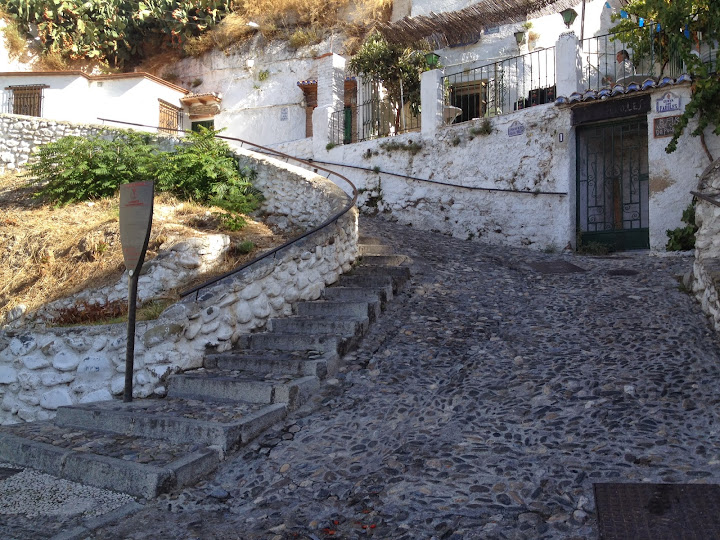
We (Ben) had to drag the suitcase up this little road, which we assumed was a footpath until we saw a car on it the next day. Most of the cars in Granada were covered in huge scratches on both sides - a cost of living in the old city, I guess.

In Granada we stayed in a cave hotel! I had originally booked a standard tourist hotel on the edge of town to avoid having to drive in the city center, but we talked about it and decided it was worth the risk to stay somewhere more atmospheric. Our cave hotel is in the right half of this picture:


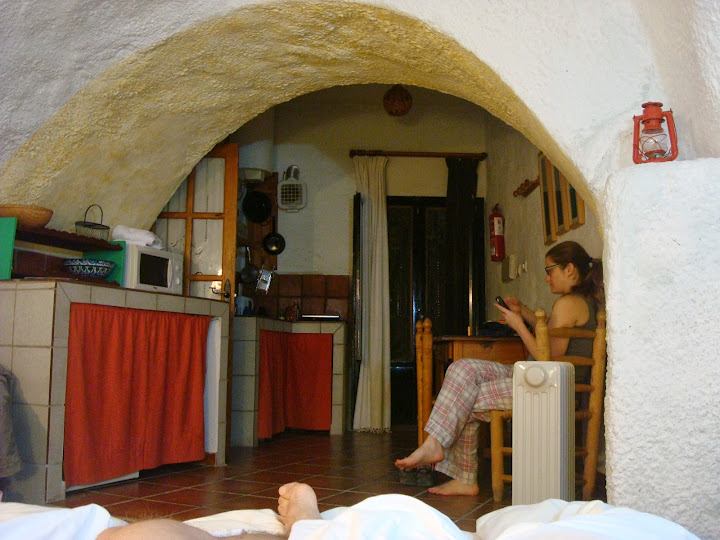
And here is our cave! It was pretty exciting. It stays at a constant temperature year-round so there is no need for air conditioning.


The proprietor told us that in three years of checking people into the caves, we were the first people to ever arrive precisely on time. I'm sure this does not come as a great surprise to people who know me.

This is the road on which Granadans apparently drive their cars, immediately outside our cave. Just around the bend there is a stunning view of the Alhambra.


We walked up the hill to the Albaycin, the old Moorish quarter of Granada. It is considered the best preserved Moorish neighborhood in Spain, and definitely had a Tunisian feel about it in places (which is our only experience with being in an old Muslim neighborhood).

In Granada there is still a culture of free tapas - meaning you order a drink and they bring you some free food as well. This is what they brought us - bread crumbs with melon and sausage. I later learned this is called migas in Spain, which is a completely different thing than migas in Latin America (tortillas scrambled with eggs). It was good, though. I'm going to figure out how to make it.


Lunch is the heavy meal of the day in Spain, and most restaurants have a thing called menu del dia, where you get three courses (starter, main, dessert) + bread and drinks, for much less than each item would cost individually. Usually they ran about $10-12 US, or, you know, the price of lunch at Chipotle. Depressing.

Here is what we got at the random place we stopped in the Albaycin - Ben's fried eggplant with "honey" (which is really molasses but everyplace we went called it honey), and my fried cheese with tomato sauce. If you guessed that both of these things were excellent you would be correct.


For my main I ordered the Alpujarras platter because I didn't know what it was. The waiter said it was "Andalucian specialties." It was seasoned fried potatoes, some various meats, and a fried egg. I ate it all up except the blood sausage. I draw a line at blood sausage.


Ben was on a fried squid kick for most of the trip. Also, every salad we got in Granada had corn on it, which was a little weird and unexpected.


After lunch we walked down the hill through the Albaycin.


We saw our first stray cats!  We saw cats in every city, but Granada had the most. 


They like cats there.


It's nice that they give you a heads up about 1.8 meters being physically impossible. We drove on a street that was 1.9.


The guidebooks we had did not seem too enthusiastic about Granada's cathedral, but we went inside anyway and thought it was very impressive. We sat for a long time just looking around.


And then we walked back up to our hotel along the Rio Darro. 


There was a cat giving himself a bath down on the riverbank! When we got back to the cave I read in Rick Steves' book, "look out for feral cats on the riverbank." How does he know?? Rick is a genius.


For dinner we had a picnic on the patio outside our cave. There was a little orange kitten running around all night meowing at the top of his lungs, which made us feel right at home. 

Here I am on the internet in the cave! 

I will never travel internationally without an iPhone again - in addition to the maps/GPS issue, it was so helpful to be able to check in at the end of the day and read about the things we saw. I didn't activate it for use overseas but with wifi you can even talk on the phone via facetime and it's all free! The world is basically amazing.

Trip Report! Day 2: Cordoba

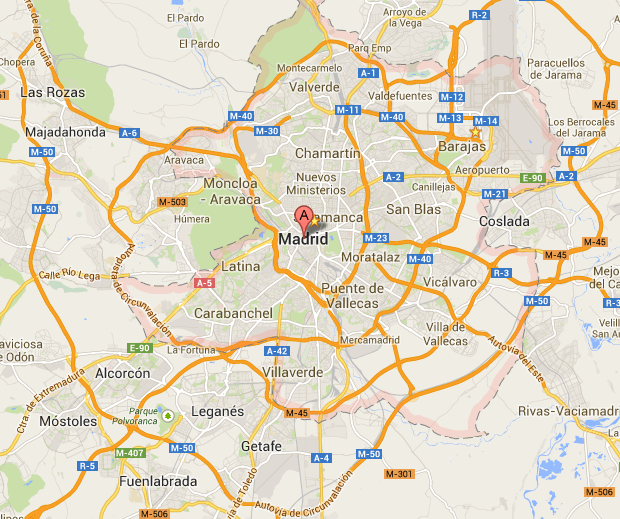
Monday morning we got up bright and early and took a cab to Madrid's Plaza Espana to pick up our car at the car rental agency. I picked that location because it was just a few blocks from the entrance to the freeway, thinking it would be relatively simple to start off the trip headed in the right direction. Ha ha. Ha. This is what Madrid looks like.


We were supposed to head south on the A-4 but the directions referred to a roundabout that never showed up and somehow we were headed southwest on the A-5 instead. There were a lot of tunnels involved.

I had spent a LOT of time preparing for this trip with Google maps - I printed out detailed directions for each leg of our trip and spent probably hours reviewing them in Street View, but nonetheless we immediately learned that if you take a wrong turn, printed out directions become instantly useless. Fortunately, I had also downloaded Triposo's Spain app, which comes with offline maps of the entire country. An iPhone has built in GPS that does not require a service connection, and these two things combined saved us dozens of times on this trip. The Triposo app was free but I'm going to write them an email offering to paypal them some money. It was absolutely invaluable for getting and keeping us on track. With the help of Triposo I was able to get us  back over to the A-4 and then we drove the four hours to Cordoba without further incident.

In Cordoba we stayed in the Hotel Hacienda Posada de Vallina, which is located immediately across the street from Cordoba's biggest tourist site, the Mezquita. I couldn't understand why the hotel wasn't featured in any of the guidebooks we had, because not only was the location was perfect, it was easy to get to by car and provided parking, both of which are relatively rare in Andalucian cities. It is also beautiful, having been built in the 13th century. Supposedly Christopher Columbus even slept there! Very exciting. Here is the interior courtyard.


Once we were actually in Cordoba, though, I understood why it doesn't have a higher profile - there are literally dozens of hotels in the tourist area around the Mezquita, and I'm sure most of them are lovely. 

The first thing we did after parking the car was EAT. We went to Bodegas Mezquita because it was just down the block from our hotel and Rick Steves said it was good. Basically we spent most of this trip doing whatever Rick Steves said we should do. We got the menu de tapas, which featured the following items:


Like every single thing we ate in Spain, it was all really good.


A lot of people do a day trip from Seville rather than spending the night in Cordoba, because the Mezquita is considered to be the only major sight worth seeing. It was built as a huge mosque during the Moorish occupation of Spain (which lasted 700 years, so it's not really all that accurate to actually think of it as an "occupation"). When the Christians reconquered Cordoba, they tore out the middle of the mosque and built a huge cathedral in the center. 


We checked it out after lunch. There is a big courtyard inside the walls.


And here are the famous arches from the mosque section. There are probably thousands of pictures exactly like this on the internet, but it's impossible not to take and post them yourself! It is really a beautiful, amazing place.


There are rows and rows of the Islamic columns, and then you come to the middle, where there is this huge cathedral built right into the center. The king of Spain approved this idea over the objections of Cordobans who wanted to preserve the building even after the Moors had left.


Here is our hotel from inside the Mezquita!


And this is the square just outside.


Parts of the old city wall still remain.


This little dog came over to say hi to me.


After the Mezquita we started wandering aimlessly, as per our usual routine in a new place. We ended up in Cordoba's commercial district, which is definitely distinct from the tourist area, unlike most of the other cities we visited.


It was a rainy day, our only one of the trip, so we stood around under the eaves of an old building drinking coffee and people watching for a while. We had our first communication mishap trying to order the coffee - Benjamin kept trying to order a double espresso but was using the terminology he had learned at Starbucks in Madrid, which we later learned is unique to Starbucks. TYPICAL. Anyway, we finally looked up "double" on the Spanish dictionary app to figure it out.


The other touristy thing to do in Cordoba is explore the city's old Jewish quarter, which is whitewashed with tiny narrow streets. 


I guess people drive here?


We went down this little alley to discover an artist's collective courtyard type area, which was interesting. Lots of little shops with artwork to buy.


We also ran across this status of Maimonides, an important Jewish scholar who was born in Cordoba.


That evening we went to Bodegas Campos, another Rick Steves recommendation. It's too bad the picture of Benjamin's dinner didn't come out because it was excellent - chicken rolled up around bacon and then breaded and fried. I ordered fried potatoes and chorizo with an egg, which is my favorite kind of food, and was not disappointed. In Spanish restaurants dishes can generally be ordered in three sizes: as tapas (smallest), half-rations, or rations. I told him I wanted the ration but he said I only needed the half and he was correct.


After dinner it was still drizzly but we wandered around a little bit before turning in. 


Cordoba was a great way to start the trip - it's a manageable size and the area around the Mezquita especially is very self-consciously oriented toward tourists, so they are used to people wandering around not knowing how to communicate in Spanish. The next day we were headed out for Granada!

Wednesday, October 9, 2013

Trip Report! Day 1: Madrid

As everyone who reads this blog probably already knows, we have just gotten back from a week and a half on Spain! It was a wonderful trip, definitely right up there with Scotland on the McClure's Top Vacations list. We saw so many things and ate so much delicious food and, while I was definitely ready to see my kitties again, we both felt like we could have stayed longer in many of the places we visited. Everyone we met was so friendly and helpful and completely unannoyed (at least visibly) at our basically horrible attempts to communicate in Spanish.

The real focus of the trip was Andalucia, the southernmost part of Spain, the part the guidebooks call "the most quintessentially Spanish" region of the country. It's the area where bullfighting began, and where flamenco and tapas and siesta are all still integral parts of the society. I had never really considered going to Spain before I read a comment by someone online about that region, and after looking into it for a couple of days I was hooked. 

Nevertheless, we decided to fly into Madrid to avoid having to change planes twice. Most people seem to not think much of Madrid - there are great art museums there, but the consensus seems to be that there isn't a lot to see there otherwise. I figured having a couple of days there bookending the Andalucian part of the trip would be a good way to catch the highlights.

We arrived, as usual, at the crack of dawn, on no sleep, and took the subway into town. 


Madrid is 6 hours ahead of Raleigh, so by the time we reached our hotel at around 8:00 a.m., it was two in the morning in our heads. We stayed at the Petit Plaza Santa Barbara, which was perfect for our needs - near a metro stop but in a quieter area outside the very center of the city. 


I had emailed requesting early check-in, but they couldn't accommodate us until 11:00 a.m., so we went out to explore the city a little bit in a semi-delirious state.


It was Sunday morning, so the streets of Madrid were very quiet. We walked through Puerta del Sol, which is sort of the heart of the city and is usually very busy, but there was almost no one around. 


A short distance away is the picturesque Plaza Mayor, also very quiet at that time. We are definitely not a fan of crowds so this whole scenario was working out pretty well for us.


We then wandered over to the area near Madrid's Almudena Cathedral and the Palacios Real. The king and queen don't live in the palace, but still use it for ceremonies and special occasions.  It is huge. You can go inside but it wasn't open yet while we were passing by.


We continued along to see the Temple of Debod, an Egyptian temple built in the 2nd century BC that was moved to Madrid and reassembled there in 1968. It was pretty weird but neat to see - the inside was full of heiroglyphics.


Finally it was time to check into the hotel, so we did that and ended up sleeping for a few hours before heading back out to the Reina Sofia Museum, which is free on Sunday afternoons. 


The Reina Sofia is Madrid's major museum that focuses primarily on modern art; its best known work is Picasso's Guernica, which is the main reason I wanted to go. We were pretty excited to be able to walk in and see Guernica for free without feeling like we had to spend money and therefore a lot of time perusing everything else. In the last couple years I've realized I'm not too big on visiting museums unless I particularly like or know a lot about the specific art.

After the museum we wandered up into a little neighborhood to find some food. The Spanish lunchtime is mainly between 2:00 and 4:00, and in Madrid we had our first of what was to be many experiences of just missing the 4:00 cutoff. We eventually found a place called La Dolores that was open and sat down to try to decipher the menu, which was a bit beyond us in our still-exhausted state. 


Fortunately they had an option of 6 tapas for 13 euros, so we did that and let the bartender pick. We were pretty impressed by what we got - but this would be a theme of the whole trip, unbelievable value and quality for hardly any money at all. One of these was squid, which I just could not bring myself to eat. I had a little bite and it did just taste like fish but the mental hurdle was too much. I have no issue with fried calamari, though, so I realize that makes no sense. Anyway, all of these things were fantastic, and made me pretty excited for the days to come.


On the way back to the hotel we passed by Madrid's city hall.


And this building, which was a couple blocks from our hotel. Madrid has a pretty bad graffiti problem, so I guess the owners of this place decided to take the bull by the horns rather than risking vandalism like so many nearby.


At this point we were ready for real sleep, and it was finally a semi-acceptable time for bed. I fell asleep at 8:00pm and slept straight through until 8:30am! 

In general my first impression of Madrid was not great, although in retrospect it seems unfair to base an impression of a city on a one-day exploration done in a state of exhaustion. It's big, and has that Big City feeling that sort of overrides much individual character. London is like that for me, too. Anyway, it was a good place to start and the next morning we were picking up our car and heading out for Andalucia!